
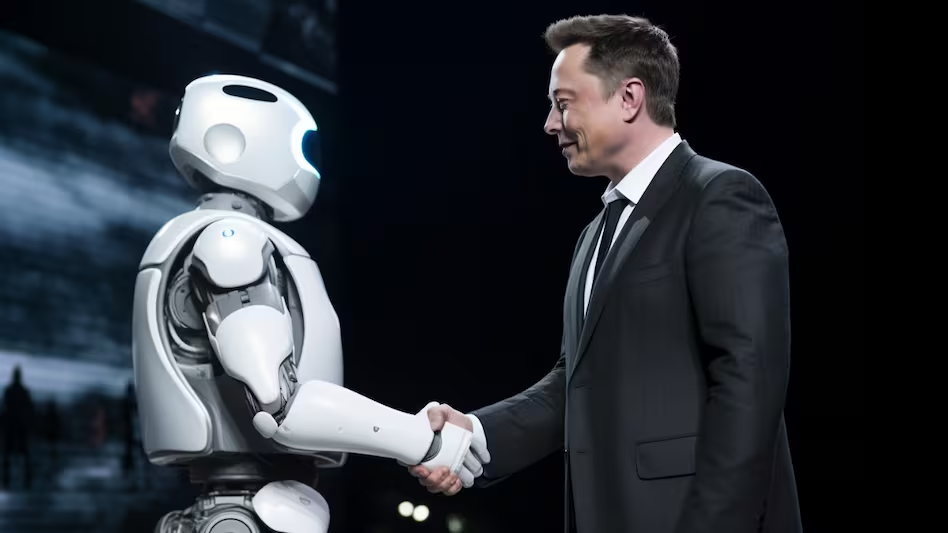
Elon Musk, the ever-polarizing force behind Tesla, SpaceX, and the newly launched xAI, is once again shaping the global discourse on artificial intelligence—this time with a sharper focus on the real-world limitations underpinning AI’s explosive growth. In 2025, Musk’s warnings have evolved beyond abstract existential threats to more grounded, strategic concerns: energy shortages, chip supply, and infrastructure capacity.
For China’s AI ecosystem—which is aggressively scaling in both the public and private sectors—Musk’s observations offer not just cautionary tales, but strategic insight into what could define the next decade of AI leadership.
The Shift from Algorithms to Infrastructure
Musk’s central argument is simple but profound: the greatest bottlenecks to AI advancement are no longer algorithmic. They’re infrastructural. As AI models demand more computational power, the physical limitations of electricity generation, chip availability, and hardware like transformers are emerging as critical hurdles.
Take xAI’s Colossus data center in Memphis, Tennessee—a facility that reportedly draws energy equivalent to a nuclear power plant. To meet its massive energy needs, Musk has resorted to natural gas turbines, sparking environmental controversy but underscoring the lack of scalable alternatives.
This is where China comes into sharp focus. Musk has publicly praised China’s rapid expansion in energy infrastructure, saying its growth trajectory is “like a rocket going to orbit.” This contrasts starkly with stagnating capacity in the U.S., a dynamic that could shift the global balance of AI power.
Powering the AI Race: A Geopolitical Fault Line
China’s strategic investment in power generation—through coal, nuclear, hydro, and increasingly renewables—positions it advantageously for large-scale AI deployment. The implications are clear: access to cheap, reliable energy may soon be as important to AI dominance as access to top-tier research talent.
This observation should resonate with China’s AI policymakers. If Musk is right, then national competitiveness in AI will depend not just on software or hardware, but on megawatt-hours and transformers.
Chinese tech giants such as Alibaba, Tencent, and ByteDance have already been scaling their data center footprints both domestically and abroad. But with the anticipated rise in energy demand for training and running frontier models, questions around grid readiness, regional power disparities, and sustainability will become increasingly strategic.
Chips, Transformers, and the Global Supply Chain Scramble
In addition to energy, Musk is sounding the alarm on the ongoing race for GPUs and transformers—key components in AI computing. While companies like Nvidia and AMD remain dominant suppliers, China’s domestic semiconductor ambitions remain central to long-term self-sufficiency.
Yet, even as the U.S. imposes chip export controls, China is advancing on its own front, investing heavily in GPU alternatives and AI accelerator chips. But Musk’s point is that chips are only one part of the puzzle; transformers—essential for voltage regulation in AI-intensive facilities—could be the next unexpected chokepoint.
This reinforces the broader theme: physical infrastructure is not merely a backdrop to the AI story; it is the stage on which the drama unfolds.
Environmental Trade-offs and Regulatory Headwinds
Musk’s use of natural gas to fuel xAI’s operations is controversial, especially given his environmentalist credentials. Critics have raised alarms over air pollution and regulatory noncompliance, reminding us that the AI boom is not without social and ecological costs.
For China, the lesson is twofold: build sustainably and regulate proactively. With growing international scrutiny over carbon emissions and environmental standards, Chinese firms expanding their AI infrastructure—both at home and in Belt and Road countries—must take sustainability seriously or risk backlash.
Musk’s Paradox: Caution and Optimism
Despite his dire warnings, Musk remains bullish on AI’s potential to drive progress—from healthcare to robotics. However, his optimism is conditional. It rests on regulatory foresight, ethical safeguards, and robust infrastructure development.
China’s regulatory authorities are already crafting AI governance frameworks, from facial recognition oversight to draft laws on generative AI. Musk’s emphasis on “responsible innovation” aligns with Beijing’s evolving tech policy, which seeks to balance innovation with control.
A Blueprint for AI Power in China
Elon Musk’s latest commentary isn’t just a reflection on American AI strategy—it’s a blueprint for global AI leadership. For China, the implications are clear:
- Invest in energy infrastructure with AI growth in mind.
- Accelerate domestic chip innovation while diversifying global hardware partnerships.
- Future-proof the grid to support emerging computational demands.
- Lead in sustainable AI by avoiding the environmental missteps others have made.
As the U.S. grapples with its infrastructural constraints, China has a window of opportunity to define what AI infrastructure leadership looks like. The future Musk envisions—powered by teraflops and gigawatts—may well be built in China.
Elon Musk certainly knows how to spark a conversation! His focus on infrastructure feels like a wake-up call for both the U.S. and China. Exciting times ahead for AI!